
Luxury Madagascar tours for comfort-focused travelers are designed for guests who want discovery, wildlife, culture, and scenery with thoughtful pacing and reliable support. Instead of rushing through long travel days, this journey balances Madagascar's highlights with organized logistics, private guidance, and time to enjoy each region properly.
This tour is especially suitable for travelers who prefer well-planned transfers, experienced guides, comfortable accommodation, and a clear itinerary from arrival to departure. Moreover, HT Agency Tours adapts the rhythm whenever possible so the experience feels immersive without becoming overwhelming.
Start Planning on WhatsApp | Request a Comfort-Focused Madagascar Proposal
Madagascar is extraordinary, but it rewards careful planning. Therefore, we design the route with realistic timing, local guidance, and practical comfort in mind, so travelers can focus on the experience rather than the logistics.
This tour package is ideal for older travelers over 50 years old and is featured among our Madagascar tours for older adults. The price (double occupancy) is per person and subject to change for custom detail.
DURATION : 15 days
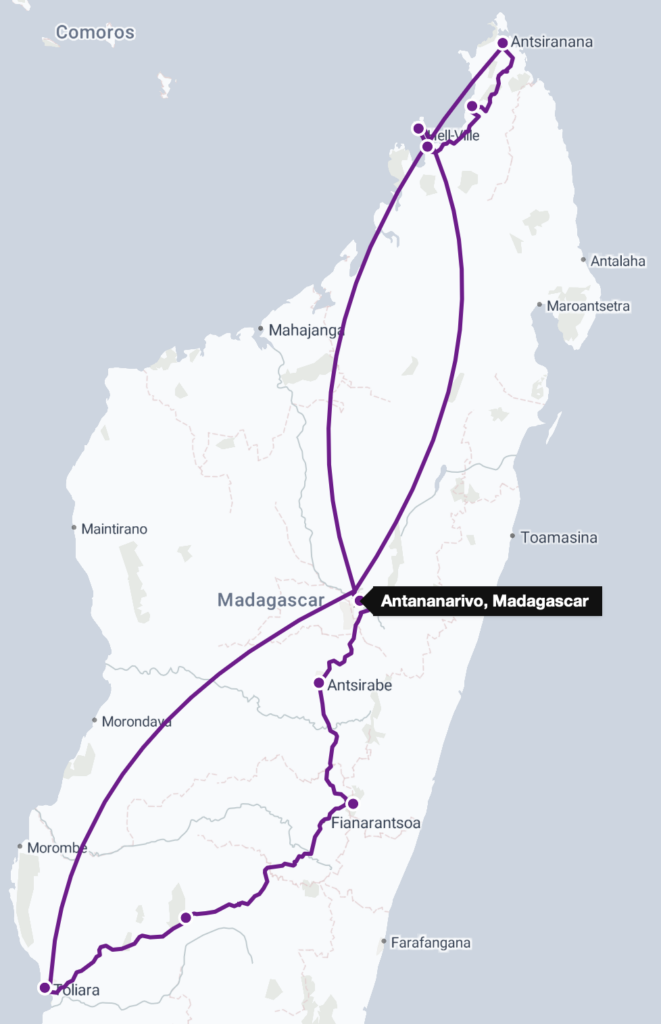
AREA : East, South and North of Madagascar
TRIP : Private
PLACES TO VISIT : Antananarivo – Andasibe – Antsirabe – Ranomafana- Isalo – Tulear – Diego suarez – Nosy Be
ACCOMODATION TYPE : 3 to 5 stars (Half Board)
TRANSPORT TYPE: Private car/Flight
BACK TO ANTANANARIVO: Flight
ASSISTANCE: Guide / Local Guide
AVAILABITY: ALL YEAR
Arrival at Ivato International Airport. You will be welcomed by HT Agency Tours Staff. Once you have cleared customs formalities, our Guide will smooth through the rest of the arrivals process – currency exchange, setting up your phone with a new SIM card, and anything else you need. We will provide 1 SIM cards with Data + National Call + 5mn International call during your stay in Madagascar. It will make our contact easier. Check in at the hotel.
Night at the NOVOTEL (Dinner and Breakfast)
After breakfast, we explore Madagascar’s capital, known simply as “Tana”. We drive to the Royal Hill of Ambohimanga, a UNESCO World Heritage Site, consisting of a royal city and an ensemble of sacred places. The Queen’s Palace here is a symbol of the Merina Kingdom, the dynasty that made Madagascar a modern state. This is a place of pilgrimage and the burial ground for its sovereigns since 1817. Sitting atop the highest hill in Antananarivo, it offers spectacular views of the surroundings.
Here we get a good picture of the diverse communities that come together from all over the island in the capital, before we take a scenic drive to Marozevo. We visit the famous exotic animal breeding centre owned by naturalist Andre Pereyras, where we see almost all the chameleon species of Madagascar – as well as butterflies, leaf tailed geckos, lemurs and other interesting animals. On the RN2 east we enjoy panoramic views of the stepped rice fields in the Highlands of Madagascar.
We see luxuriant vegetation, with stops along the scenic rainforest route in world-renowned Andasibe-Perinet National Park, seeing primary forests. After check-in at the hotel, around 6:30PM, you end this day with a guided night visits which will take 1 hour and half, and then drive back to the hotel.
Night at MANTADIA LODGE (Dinner and Breakfast)
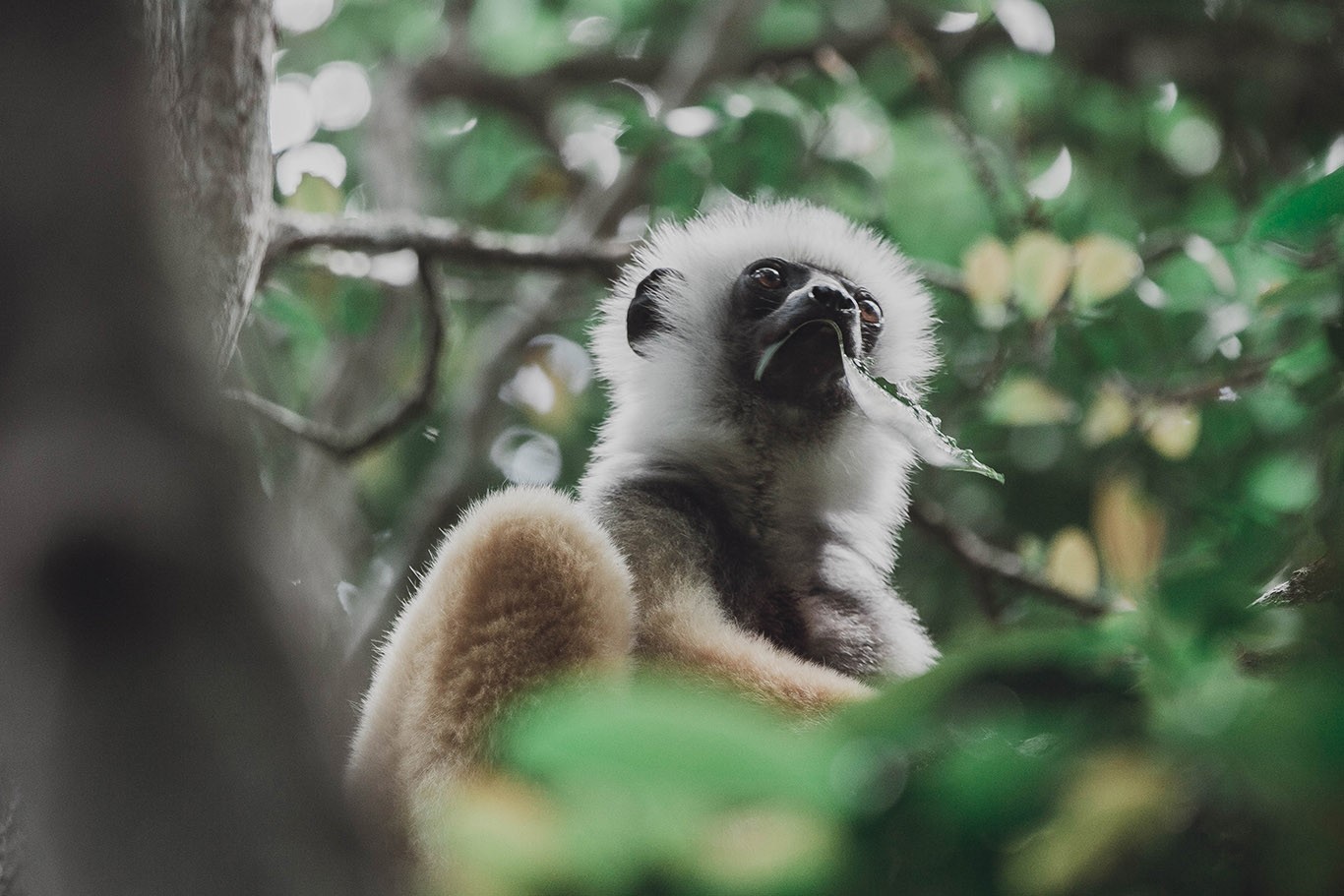
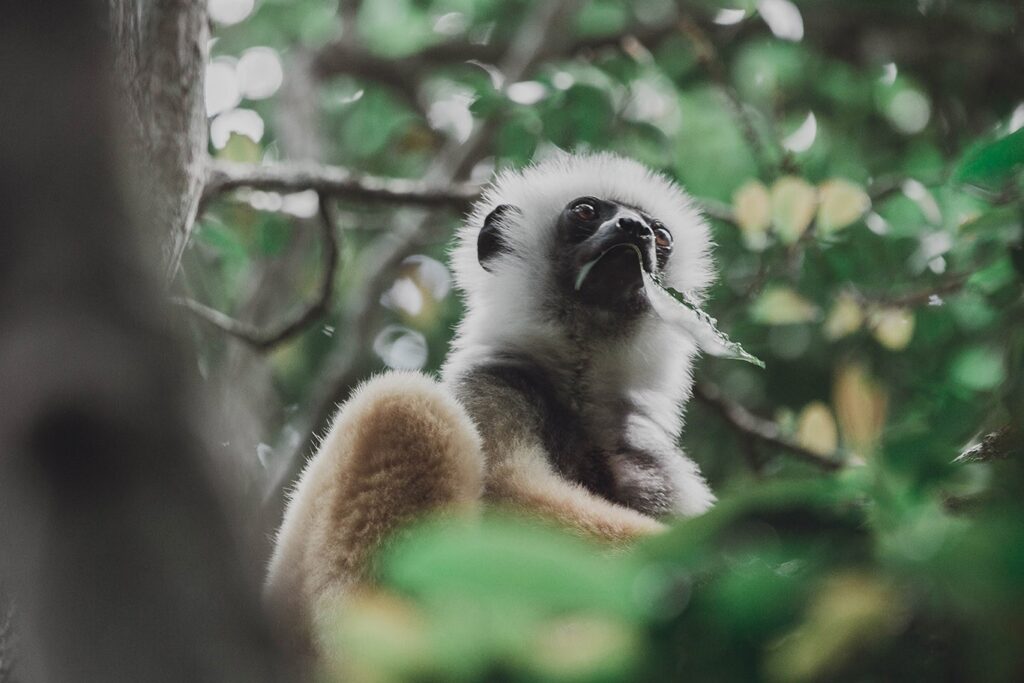
After breakfast, you start with a guided visit at Analamazaotra National Park. It is better to leave the hotel early (about 7:30AM) to meet easily the Indri-Indri and the Diademed Sifaka in their forest home. The visit takes about 3 hours. Within a mile of the park you can hear the peculiar call of the indri very early in the morning until noon and again in the late afternoon.
(called Babakoto in Malagasy) are the largest living lemurs at all reaching up to 1 meter. Andasibe is the best place to observe the Indris given that there are a couple of families habituated to humans. It lives in small groups and cannot survive in captivity. There are several legends trying to explain its origins since it is considered a sacred animal in the whole Madagascar.
Another 13 lemur species inhabit these forests, such as woody lemur, grey bamboo lemur, diademed sifaka, brown lemur, red mouse-lemur, red-bellied lemur, black and white ruffed lemur and even aye-aye. In the afternoon we will enjoy an amazing up close and personal experience with lemurs on the private Lemurs Island and then on to view many other species in the Vakona Reserve Zoo, where you will see many crocodiles in the huge river enclosure, native birds, and other wildlife in well-kept surroundings.
Night at MANTADIA LODGE (Dinner and Breakfast)
We depart early and have a full day drive through spectacular eroded hills called ‘lavaka.’ This area will remind you of Southeast Asia with its terraced rice fields, thatched houses and green landscapes of vegetables and fruit trees. We return west along the RN2 almost as far as Antananarivo before turning south onto the famed RN7.
We visit the metal workshop of Donné Vy and stop in Behenjy, a little town which is known for its production of paté de foie-gras. We also stop in Ambatolampy to see aluminum pot making. Our destination is the highland town of Antsirabe, with its wide colonial streets, volcanic lakes and colourful rickshaws. “The Place of Salt” is the centre of beer making in Madagascar and is known for its handicrafts.
Founded by Norwegian missionaries in 1856, it is the only place which really feels and looks like a European city – with its elegant spa and the railway station. It has a temperate climate and so fruits and vegetables which grow in cooler parts of the world are grown here. We visit a number of the town’s famed craftspeople to watch them working on the precious and semi-precious stones that Antsirabe is famous for, as well as seeing embroidery making.
NIGHT AT THE ROYAL PALACE (Bed and Breakfast)
Today we continue to wind our way through the Highlands’ scenic landscapes, where the houses are made with ornately-carved wooden balconies and shutters with bright colours. Further on we pass the ‘le col de tapia’, a type of tree resistant to bush fires. The landscape is still dominated by very photogenic rice fields, pine forests, eucalyptus trees and rocky hills. At the Malagasy arts and crafts capital, Ambositra, we stroll through the city visitting workshops of Zafimaniry artisans – skilled sculptors working on marquetry rosewood and ebony. We also see the Zafimaniry weavers of “landikely” and “landibe” silks.
Night at THERMAL HOTEL (Dinner and Breakfast)
This morning we search Ranomafana National Park‘s rainforest for lemurs, accompanied by our local naturalist guide. This is a high-altitude rainforest reserve where the Golden Bamboo Lemur was discovered in 1986.
The forest is home to 11 other lemur species, endemic chameleons, Leaf-tailed Geckos, Mantella Frogs and a myriad of birds. We embark on a quest to see the fabled “Hapalemur aureus” – the Golden Bamboo Lemur – which is only found in Ranomafana. We will also see many different species of birds, such as Ground Rollers. The park is particularly rich in flora and features many plant varieties unknown elsewhere, including different types of orchids and ferns.
The approximately 40,000 ha of Parc National de Ranomafana, with its rain forest-covered hills and abundant wildlife, has long been considered one of Madagascar’s highlights. Altitudes in the park range from 800 to 1,200 metres above sea level. In addition to its densely-forested hills, Ranomafana’s terrain is characterised by numerous small streams which plummet down to the beautiful Namorona River. Although much of the region has been logged, the park retains relatively large areas of primary forest. This day includes strenuous walks in the rainforest.
Before dinner we join the group on an included night guided walk in the area around our hotel to try and spot the Rufous Mouse Lemur, the Greater Dwarf Lemur and some of the other nocturnal wildlife.
Night at THERMAL HOTEL (Dinner and Breakfast)
Early departure to drive via Fianarantsoa, cultural capital of the Central Highlands, to the pleasant rural town of Ambalavao. This is the site of one of the largest livestock markets in the South (Wednesday mornings only.) We visit a local winery and a workshop making the unique Antemoro paper, which is hand made from the bark of a local tree using a method is inherited from Arab culture. We also visit a silk factory in town and learn about the local way of making fabric from silk thread and the process of dyeing it with natural dyes.
We then continue to Anjar Community Reserve for a short walk, during which we have the chance to see Madagascar’s iconic animal – ring-tailed lemurs (Lemurian Catta.) In the past, visitors fed the lemurs, so the majority of the animals are unafraid to come near us to pose for photographs. We continue to Ihosy, capital of the Bara tribes, who are herders of Zebu cattle. Further on we pass the volcanic peaks of the Andringitra massif, which serves as a transition between the green Highlands with its very spectacular granite rock formations and the dry south.
Our journey south takes us through a landscape of rock formations typical of the dry Grand South, some of which are sacred. We pass through the legendary ‘Porte du Sud’ and cross the desolate expanse of the Plateau de Horombe with its deep red soil, arriving late afternoon in Ranohira, gateway to Isalo National Park.
Night at ISALO ROCK LODGE (Dinner and Breakfast)
Today we explore the stunning desert plains, deep canyons, sandstone formations, grasslands and palm-lined oases of Isalo National Park. We hope to encounter the 3 lemur species that are found here – Red-fronted Brown Lemurs, Ring-tailed Lemurs and the loping, bipedal Verreaux’s Sifaka. We will also see vegetation such as Uapaca bojeri, Pachypodium rosulatum or ‘elephant’s foot’ and Aloe isaloensis, a native species of aloe endemic to Isalo.
The eroded mountains also served as a place where the Bara people kept their dead before they could bury them in their actual tombs. This day includes strenuous walks. “Picnic lunch in the park”. In the evening, drive back to the hotel with one stop at the famous window of Isalo to appreciate a breathtaking and spectacular sunset.
Night at ISALO ROCK LODGE (Dinner and Breakfast)
This part of our journey continues down the paved RN7 to its end in Tulear on the Southwest coast, introducing us to new scenery among the dry forests of the west and the spiny desert of the south. We pass through the sapphire mining boom town of Ilakaka, a frontier town vaguely reminiscent of the Wild West. En-route today we see the locations of different ornate hillside ‘Mahafaly Tombs‘, which were built for chiefs and kings and are covered in stones, sculptures and horns.
The more important the deceased, the more horns and statues the with. One of the largest tombs has over 700 horns of zebu cattle! As this is a sacred site we will just be passing by. tomb is adorned Photography is not permitted. We also pass the area of the ‘Antandroy Tombs‘. This is the driest part of the country – called the “Deep South” – where the landscape is dominated by cactus-like, spiny forests of different euphorbias. In this area giant baobab trees, which can be hundreds of years old, grow.
For most of the year these hardy trees have no leaves, so their bare branches look like roots – giving them the name “upside-down trees.” This is an area of dry and sandy soil where the local people battle to find drinking water. When we reach Tuléar (also known as “Toliara“), we transfer to Tulear’s airport and fly back to the Antananarivo, where we transfer to our hotel.
Night at NOVOTEL (Dinner and Breakfast)
Early this morning we fly from Antananarivo to Antsiranana, also known as Diego Suarez. This major port at the very northern tip of the island has fascinating architecture and history, with wide streets, old colonial-era buildings, amazing views of the bay and a genteel air. We explore the town before visiting Les Trois Baies on the eastern side of the peninsula – a series of beautiful bays with stupendous beaches. There are many coves and inlets along this stretch of the coast, but the area is named after 3 majestic bays: Baie de Sakalava (Sakalava Bay), Baie des Pigeons (Pigeon Bay) and Baie des Dunes (Dune Bay). This is a wild and starkly beautiful environment with not a village in sight.
Night at ALLAMANDA (Dinner and Breakfast)
From Diego Suarez we drive out to see one of Madagascar’s most impressive natural wonders:
Departure after breakfast for the montagne d’Ambre located in an entire volcanic Quaternary. Guided tour of the mountain offering discovery of rich flora through a significant rainfall regime (large trees like the “Ramy” a strong odor of turpentine, “Famelona” a therapeutic virtue, “Rotra” Edible fruit and ficus …) fauna consists of various species lemurs (crowned lemur, lemur Sanford, the lemur microcèbe, the Aye aye …), birds (rock thrush, Crested Ibis …), foxes, butterflies.
Continue to the massif of Ankarana with stop for visiting the “Tsingy Rouge”. 50 km in south of Diégo-Suarez is a beautiful group of red tsingy, especially when we take advantage of the beautiful light in the afternoon. These tsingy comes from erosion also called “Lapiaz”. The mixture of different oxides and the work of time gave birth to a set of a few hundred small fairy chimneys.
Night at the ANKARANA LODGE (Dinner and Breakfast)
This morning we drive south through the interior of northern Madagascar to the small, tree-lined town of Ambanja on the Sambirano River. This area is famous for its large cocoa, spice and vanilla plantations. From here we board a boat for the island of Nosy Be, known as “the ‘perfumed isle”, where we enjoy the “mora mora” (literally, “slowly slowly”) lifestyle. The island is paradise for water-based activities.
Night at the ANDILANA BEACH (Dinner and Breakfast)
We start our exploration of the Nosy Be area at Lokobe, a typical fishing village situated in the middle of a ylang-ylang plantation in the southeast of the island. Here we visit the Réserve Naturelle Intégrale de Lokobe, which protects most of the island’s remaining endemic vegetation. We will also see cultivated plant species such as ylang-ylang trees, vanilla orchids and travellers’ palms.
The reserve is home to the Black Lemur (the male is dark brown, almost black, while the female is a lovely chestnut colour with white tufts around her ears and cheeks) and several other lemur species. Setting off by fast boat, we visit the small island of Nosy Tanikely, which became an underwater reserve in 2010 and is known for its unrivalled snorkeling. A radius of 700 metres around the lighthouse marks the natural reserve area.
Night at the ANDILANA BEACH (Dinner and Breakfast)
For this last day, you will be transferred directly to the airport of Nosy be for flight back to the capital Antananarivo. On arrival, 45mn visit in the Queen’s Palace on the top of the hill (Rova Manjakamiadana), followed by a shopping and some souvenirs at the craft market (Depending on our time of arrival in Tana, there may be time for last-minute).
Night at NOVOTEL (Dinner and Breakfast)
After breakfast, transfer directly to the international airport for your external flight.
Our travel experts are here to assist you
(+261) 34 20 001 98
harintsoatoky@ht-agency-tours.com